WELCOME TO THE RAPE OF THE VAULTS OF SOME NOTORIOUS RS COLLECTIONS! JUST FOR RECREATIONAL PURPOSES ONLY!

Wednesday, July 4, 2012

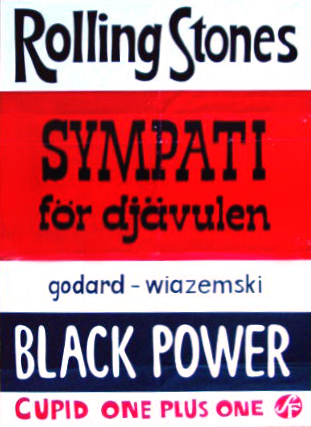
One Plus One

One Plus One  (aka. Sympathy For The Devil)
Directed by: Jean-Luc Godard
Producers: Eleni Collard/ Michael Pearson/ Iain Quarrier
Running time: 110 min   Color   Date: 1968


In the 60's, having as the background the rehearsal and recording of "Sympathy for the Devil" by the Rolling Stones, Godard discloses other contemporary revolutionary and ideological movements - the Black Power/Black Panthers, the feminism, the communism, the fascism - entwined with the reading of a cheap pulp political novel divided in the chapters:
"The Stones Rolling"; "Outside Black Novel"; "Sight and Sound"; "All About Eve";
"The Heart of Occident"; "Inside Black Syntax" and "Under the Stones the Beach"


Godard's documentation of late 1960's western counter-culture, examining the Black Panthers, referring to works by LeRoi Jones and Eldridge Cleaver. Other notable subjects are the role of the media, the mediated image, a growing technocratic society, Womens Liberation, the May revolt in France and the power of language. Cutting between 3 major scenes, including the Rolling Stones in the studio, the film is visually intercut with Eve Democracy (Wiazemsky) using graffiti which amalgamates organisations, corporations and ideologies. Godard also examines the role of the revolutionary within western culture; "There is only one way to be an intellectual revolutionary, and that is to give up being an intellectual". During filming of the Rolling Stones' recording, a fire broke out in the sound studio. While footage of the studio on fire was not included on the film, it does exist and has been used in a documentary film, "Voices".
"One Plus One" was premiered at the National Film Theatre, London, late 1968, and the film was not released in America until 1970. Producer Iain Quarrier had re-titled the film "Sympathy For The Devil", having re-edit and reworked the material (against Godard wishes) to include longer sequences with the band and the full version of the Stones song in the end.


Tuesday, July 3, 2012

Jimi Plays Monterey


Jimi plays Monterey (aka. Otis & Jimi at Monterey)
Directed by: D. A. Pennebaker

Running time: 68 min   Color   Date: 1967/68


Pennebaker´s second film, released in 1968 from footage shot at the Monterey Pop Festival starring Otis Redding
and Jimi Hendrix, introduced by Brian Jones on stage (Brian also appeared briefly in Pennebaker´s "Monterey Pop")


KRLA Beat, July 15, 1967
An interview with Brian Jones in Monterey

'Stones Freed'


Rolling Stones Freed
Movietone/British Pathé   News-reel
Running Time: 1:17 min   B&W   Date: 1967


News-film about the Stones freed in drugs case, showing Mick Jagger and Marianne Faithfull arrival
at Law Courts. Jagger walk into the office for press conference and poses for the cameras

Monday, July 2, 2012

Tonite Let´s All Make Love In London


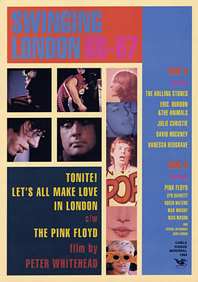
Tonite Let´s All Make Love In London {subtitled: A Pop Concerto For Film}
Directed by: Peter Whitehead
Running Time: 70 min   Color   Date: 1967


One of the few film-makers trusted within the perfumed gardens of the 60s rock illuminati, Whitehead was allowed unparalleled access into the centre of the pop circle to capture the moment for his kaleidoscopic film. With contributions from the likes of Michael Caine, Julie Christie, Lee Marvin and David Hockney, Tonite Let´s All Make Love In London presents a dazzling and intimate record from the very core of the “in-crowd”. With music by Pink Floyd, Chris Farlowe, The Small Faces, Twice As Much among others


Peter Whitehead's disjointed Swinging London documentary, subtitled A Pop Concerto, comprises a number of different "movements," each depicting a different theme underscored by music: A early version of Pink Floyd's "Interstellar Overdrive" plays behind some arty nightclub scenes, while Chris Farlowe's rendition of the Rolling Stones' "Out of Time" accompanies a young woman's description of London nightlife and the vacuousness of her own existence. In another segment, the Marquess of Kensington (Robert Wace) croons the nostalgic "Changing of the Guard" to shots of Buckingham Palace's changing of the guard, and recording act Vashti are seen at work in the studio. Sandwiched between are clips of Mick Jagger (discussing revolution), Andrew Loog Oldham (discussing his future) and Julie Christie, Michael Caine, Lee Marvin, and novelist Edna O'Brien (each discussing sex). The best part is footage of the riot that interrupted the Stones' 1966 Royal Albert Hall concert. The Stones appear to be performing "Lady Jane" but with the
band´s "Have You Seen Your Mother, Baby?" promo film in slow motion (quite a lot of this and some unused footage from Albert
Hall show will appear later on film by Whitehead and even on a few TV documentaries in the late 70s, early 80s).


Tonite Lets All Make Love in London
Instant Records INLP 002
Date: 1968

track listing:
Side One
Pink Floyd: "Interstellar Overdrive"
Marquess of Kensington: "Changing of the Guard"
Twice as Much: "Night Time Girl"
Chris Farlowe: "Out of Time"
Side Two
Pink Floyd: "Interstellar Overdrive" (Reprise)
Vashti: "Winter Is Blue"
Chris Farlowe: "Paint It, Black"
The Small Faces: "Here Come the Nice"
Pink Floyd: "Interstellar Overdrive" (Reprise)


Sunday, July 1, 2012

'Rolling Stones'


Rolling Stones
Polska Kronika Filmowa   News-reel
Running Time: 2:33 min   B&W   Date: 1967


The first time a rock band from the "West" play behind the Iron Curtain, at the Palace of Culture and Science building in Warsaw, Poland, on April 13, 1967. The tickets to the concert were given out by the Communist Party much to the bands dismay. Incredible footage from both the Stones show and the crowd outside waiting to see a glimpse of the western rock stars. Includes part of "Paint It Black" and "Satisfaction" live on stage

Saturday, June 30, 2012

A Degree Of Murder

Mord Und Totschlag {aka. A Degree Of Murder}
Directed by: Volker Schlöndorff  Producer: Rob Houwer  Music: Brian Jones
Running Time: 87 min   Color   Date: 1967


When a young woman accidentally kills her ex-lover during a fight, she decides to conceal the body. Then she becomes involved with not one but both of the men she finds to help her dispose his body at a construction site. And this is just one of her many problems!
Brian Jones scored the soundtrack and shows up in a scene


Despite its film noir trappings, director Volker Schlondorff's dispassionate thriller transcends its sub genre to become a more broad-based study of alienation and angst in West Germany during the 1960's. Clearly a product of its times, the film stars Anita Pallenberg as Marie, who shoots her ex-lover (Werner Enke) when he comes to her apartment and attempts to rape her. Brian Jones, who was dating Pallenberg at the time, makes a brief appearance in the film as well as writing and performing the bouncy score.
A Degree Of Murder was Germany's entry for the Cannes Film Festival of 1967, held April 24-May 11, 1967. Although he attended the festival, any pride in his soundtrack work was crushed by Anita's presence at the festival. Brian left the day before the festival ended, only to return to his London flat to be busted by Scotland Yard within hours for drug charges. With the loss of Anita and his impending drug trial, Brian never really got a chance to celebrate his success.
Unfortunately, an official soundtrack has never been released. Several bootlegs claiming to be the 'soundtrack' have appeared, but they are all straight dubs from the film, with dialogue present and often in terrible sound quality.
The soundtrack was recorded at IBC Studios between late 1966 and early 1967 with all music composed, arranged and produced by Brian (with Glyn Johns engineering). The soundtrack also featured session musicians Jimmy Page (guitar), Nicky Hopkins (piano), Peter Gosling (background vocals; rumoured to have played Mellotron), Kenny Jones (drums) and Mike Leander (Orchestra). Brian played all the other instruments including: sitar, organ, recorder, banjo, harpsichord, autoharp, dulcimer, clarinet, and harmonica.


KRLA Beat, April 8, 1967


Friday, June 29, 2012

Only Lovers Left Alive


Original wraparound picture by made-to-order photographer Bruce Fleming
Only Lovers Left Alive


photography: Bruce Fleming
According to Andrew Loog Oldham, the Stones' manager, at first he and the band attempted to secure the rights to Anthony Burgess's 1962 novel A Clockwork Orange, but Burgess had already sold the rights to Stanley Kubrick. Oldham and the Stones settled instead on "a second best novel", Only Lovers Left Alive. The Rolling Stones (plus Marianne Faithfull) were about to receive $1 million for making their acting debut in the movie, that would go into production at MGM´s Boreham Wood Studios in the fall of 1966. Their business manager, Allen Klein has also negotiated a $3 million recording contract with Decca for the music.
The book was originally issued in 1964 and the story is from a novel by Dave Wallis, about an imaginary takeover of England by violent and rebellious teenagers once all the adults have been killed, The Seely Street Gang, made up of a number of types of young Brits, including one Mod, struggle to survive the devastation. In the beginning they go wild, orgies of sex, wanton destruction, surging fighting with other gangs, then they face assorted hardships, widespread power outages, a new form of plague, bands of wild dogs and an unexpected pregnancy. It never materialized. Only Lovers Left Alive was forever consigned to "best films never made" lists. When you consider Stones tracks from 1966 that may have found themselves on the ‘Only Lovers Left Alive’ soundtrack if they’d ever got that far, the film would have had a great soundtrack. ‘Mothers Little Helper' and 'It's Not Easy' would fit into any number of scenes. In fact, the album Aftermath was to have been the soundtrack for the never filmed feature Back, Behind And In Front. Filming was about to start in April 1966, and though Oldham had a basic plot for the film, nothing ever happened.
Another "lost film"in this list is Maxigasm, a Carlo Ponti film scheduled, but never shot, with the Rolling Stones in North Africa, late 1968.


KRLA Beat, June 4, 1966
There were persistent stories in the press in 1966 that the movie was underway, and that Nicholas Ray was attached to direct, although Ray apparently got as
far as writing a script, in the end he "was unable to find financial backing, and the Rolling Stones stars lacked confidence in Ray, and the whole matter dissolved"

NEW MUSICAL EXPRESS  September 21, 1968